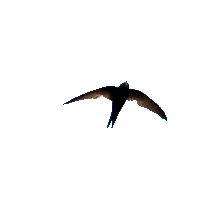
Swifts are mostly dark brown, with quite wide, thin sickle shaped wings. They have a slightly white chin, but you’ll be hard pressed to notice. Swallows and martins have larger white patches and are usually slower and more casual. They often settle on telegraph wires especially before their migration a bit later in the year than the swifts. Swifts have ineffective legs a bit like their distant cousin the T-rex, and never land except in their nest site, if they have one. Inside their nest they are very clumsy and their wings don’t fold up very neatly as they are so long. They scrabble about and somehow manage. In the air though it’s a totally different story. Single and homeless couples may never land at all from one year to the next. Another breeding opportunity wasted = more strain on their local community stability. They just need a place to make their home.
They have a wingspan of about 40cm and they weigh about the same as a cream egg, around 40g. Next time you see one, pick it up and feel the weight. They can fly an equivalent distance of 4 return trips to the moon during their lifetime, running on 4 star insect protein!
Swifts can be a bit fickle about their nesting sites, and it can take several years for them to move into their lifetime home to make a family.
They have to date first of course! Another job done in the air, usually during a party.
Sound familiar?
Then they need to find a suitable home together, which isn’t easy these days as there’s a housing shortage.
Sound familiar?
If they can’t find a nesting site, they just hang out around the streets, larking about with their mates, being noisy, that’s when they are not eating of course.
Sound familiar?
To me, the similarities to humans and their almost secret proximity is fascinating.
Once first timers find a hole or box, they will go up to it and literally crash into the doorway to check if the house is occupied. These are called “bangers”. If anyone’s at home, they will come to the entrance to check the commotion and will be spotted and told to scarper. If they find a vacant property, they get their mate on the case and set up the house a year before actually laying any eggs, so they can get down to business quickly on their return the next year. There’s no time to decorate during the breeding season!
They also need to get back sharpish next year, so they have time to dish out an eviction order to any sparrow squatters that may have broken in through the 30mm high front door. They have a very clever method of not gazumping each other though; Couples ready to have a family come back early. Bangers, wait a few weeks before coming into town in a later wave from Africa. So in theory, they will eventually discover empty nests during their door to door enquiries rather than gazump a successful family. Isn’t evolution amazing?

Getting an early start is important as there’s only a few weeks to get a brood fit to fly anyway before weather and food supply starts to deteriorate. They need long daylight hours and plenty of insects in the height of our summer.
Most other young birds still get fed and cared for after leaving a nest. Swifts have to be flight ready before they jump for the very first time and then totally self-sufficient. They have to learn on the job, and ours have got to get across the channel on their first attempt where food might be harder to find. Northerners can stoke up and practice their aviation skills a bit more before their sea crossing.
Once the nest site has been chosen, they will work out the best flight path to get into the front door efficiently, and with needle sharp precision. They approach at up to 30+ mph into a hole that’s about 28mm high, missing our telegraph wires into the mix. They will follow this approach line year after year. Never move a nest box once it’s in place as they remember exactly where the hole is and it has been known to cause injury if they misjudge their approach.
Once they have their new place, it needs furnishing. They collect what they can from the air to line a very sparse nest, usually just a few feathers that they find floating about in the breeze. Or seed fluff, wool or even human hair caught in an updraft has been found inside nests. Even bits of plastic film. Yes, it gets in there too! They glue these feathery pieces down with some spit. It looks pretty basic at times. We can help them by placing a nest ring inside their box to stop their eggs from rolling about and also add a few feathers from an old pillow to get them cozy from the start.
Once the nest is ready, the new couple might camp out together in it for a few nights, probably with a bit of mutual preening and bonding, then they completely separate on their winter excursion and arrange to meet back at the house in early May for some seriously hard work. In the time that they are away from the nest you have enough time to have a baby! They are still up there, every single second of every day! If your birthday is in the first week of May, you are blessed 🙂
On arrival back at the house in early May, they have a bit of a kiss and cuddle to greet each other after such a long break, then it’s down to business for 8 weeks or so, incubating and feeding continuously.
They will stay together for about 7 years or so, raising about 2 chicks per year. This process doesn’t always go smoothly. Sometimes, there’s bad weather and that can also cause a local shortage of food, so they might have to go on a day trip to Europe, just to get lunch! They can leave the kids home alone for a day or two in an emergency without them coming to any harm or starving. These chicks are much tougher than most other birds.
Due to lifetime bonding they are also subject to dealing with various emotional situations. If their partner fails to return from the winter migration for instance. They also have affairs if one partner arrives back from their winter holiday a bit late and the first one has given up waiting and has found a new mate in the meantime. A few fights over partners may ensue, but otherwise they are calm and businesslike with the occasional party madness. Sometimes there’s a single parent left to bring up the family on their own if the other one has come to grief for some reason. That can work out, even if only one chick gets enough food to survive.
Some experiments are being carried out now with adoptions. Some birds wouldn’t tolerate this, but swifts are accepting them apparently, even if they are different ages.
The chicks grow fast. They eat everything offered and can even put on too much weight if there’s plenty of food about, which actually makes them too heavy to fly! They are aware of this and will go off their food if they are close to fledging in order to be in perfect shape for lift off. They convert the excess fat into flight feathers and muscle to get down to a perfect weight. It’s almost unbelievable, but they do actual press-ups in the nest to strengthen their wings and get themselves trim and ready for their first flight. It has to be seen to be believed. Search for “swift press ups” on YouTube!
They start having a look out of the window a few days before leaving in July to see the world to come and plan their inaugural flight trajectory. When ready, they wait for the parents to go out for a takeaway, and then sneak off without saying goodbye! From the second they jump, they are on their own!
The parents then suffer from empty nest syndrome! They come home with the food shopping, and there’s no one there! They are clearly affected by this when you watch camera footage. They might then tidy up a bit ready for next year, and they then go back to Africa straight away. Even that might be to help retain the local food supply for later fledgers. The children might hang around the area for a while, imprinting their home GPS location and building up their reserves for the journey ahead. They won’t even come back at all now for maybe the first two years, so having a good memory of their birthplace helps. It’s possible that they might meet their parents around town in two years time, looking for their own first house. No one knows their other secrets yet as they are so hard to track. Even males and females can’t be identified easily. And how do they know from birth how to get to East Africa for instance? Or which route to take to avoid the Sahara desert? Incredible or what?
I hope you’ve found this simplified life story fun, interesting, and inspiring.
As you have seen, these birds are very special. Many birds will nest in your roof, or garden. Many birds around the world lead a very private life and can only be seen on the BBC 🙂 But the Common Swift is one of the oldest birds and yet it depends on humans now for its survival in the UK in a way that trumps all other birds. And you don’t even need to feed them for them to make your home their permanent family residence. A couple (or more!) can share your house for maybe a decade, providing you facilitate it.
They remind us of how important stable family life is, and then make us wait for 9 months to even see them again! – the exact time it takes us to expand our own family. They have total freedom to wander, something we often yearn for. They give us a summer holiday feeling. They remind us visually and through sound how to be happy, excited and free. And they only do that when they are here during our summers. It’s as if they bring us a message each year, a reminder about life.
Surely that deserves our attention?
Hopefully, you are now eager to help our community support these miracles of nature to see them around town from the beginning of May to maybe just into August.
This way to ➡️ 5. Scream watch